The Bang that broke science
 Grace Sylvester · July 11, 2026 · 11 min read
The Story of How We Discovered the Big Bang Theory
Most of are familiar with the Big Bang Theory, the idea that the entire universe exploded into existence from an incredibly hot, dense point roughly 13.8 billion years ago.
What many may not be familiar with is the fascinating drama behind it, filled with brilliant minds, heated debates, lucky accidents, and observations that changed how we see the world and our place in it.
The Real Father of the Big Bang
In the quiet halls of a Belgian seminary in 1927, a young Catholic priest named Georges Lemaître pored over equations that most theologians would never touch. Fresh from the trenches of World War I (where he had served as an artillery officer), Lemaître had earned doctorates in mathematics and physics while still wearing the collar.
He revered Einstein’s general relativity, but something nagged at him: a “static” universe didn’t add up. The math and the evidence pointed to motion; to a cosmos that was anything but still. In 1927, working almost in isolation, Lemaître published a paper in an obscure Belgian journal. He solved Einstein’s field equations for a universe that was not fixed but expanding, its galaxies racing apart like dots on an inflating balloon.
Streams of red light (“Redshift”) in distant nebulae, he argued, proved that space itself was stretching. He even calculated a rough value for what later became known as the Hubble constant, years before Edwin Hubble’s landmark observations.
But, the paper sank like a stone. The scientific community barely noticed.
Einstein’s Eternal Universe
Meanwhile, German theoretical physicist Albert Einstein, Lemaître’s contemporary, was already famous. In 1920 his theory of relativity revolutionized our understanding of gravity, space, and time. When he applied his new equations to the universe as a whole, he expected a cosmos that had always existed in a steady, unchanging state. To make the math work, he introduced an extra variable called the cosmological constant; a kind of “push” to counteract gravity and keep everything balanced.
Einstein wasn’t alone in preferring a timeless universe. Many thinkers found comfort in the idea of an eternal world without a beginning. It didn’t beg the Big Question. But the equations hinted at an expanding universe, which meant it at one point started expanding, something Einstein initially resisted.
Lemaître’s 1927 paper showed that, if the universe is expanding today, it must have been smaller and denser in the past. Rewind far enough, and all matter, energy, space, and time itself emerged from a single “primeval atom.” One explosive instant; “a day without yesterday.”
When Lemaître Met Einstein
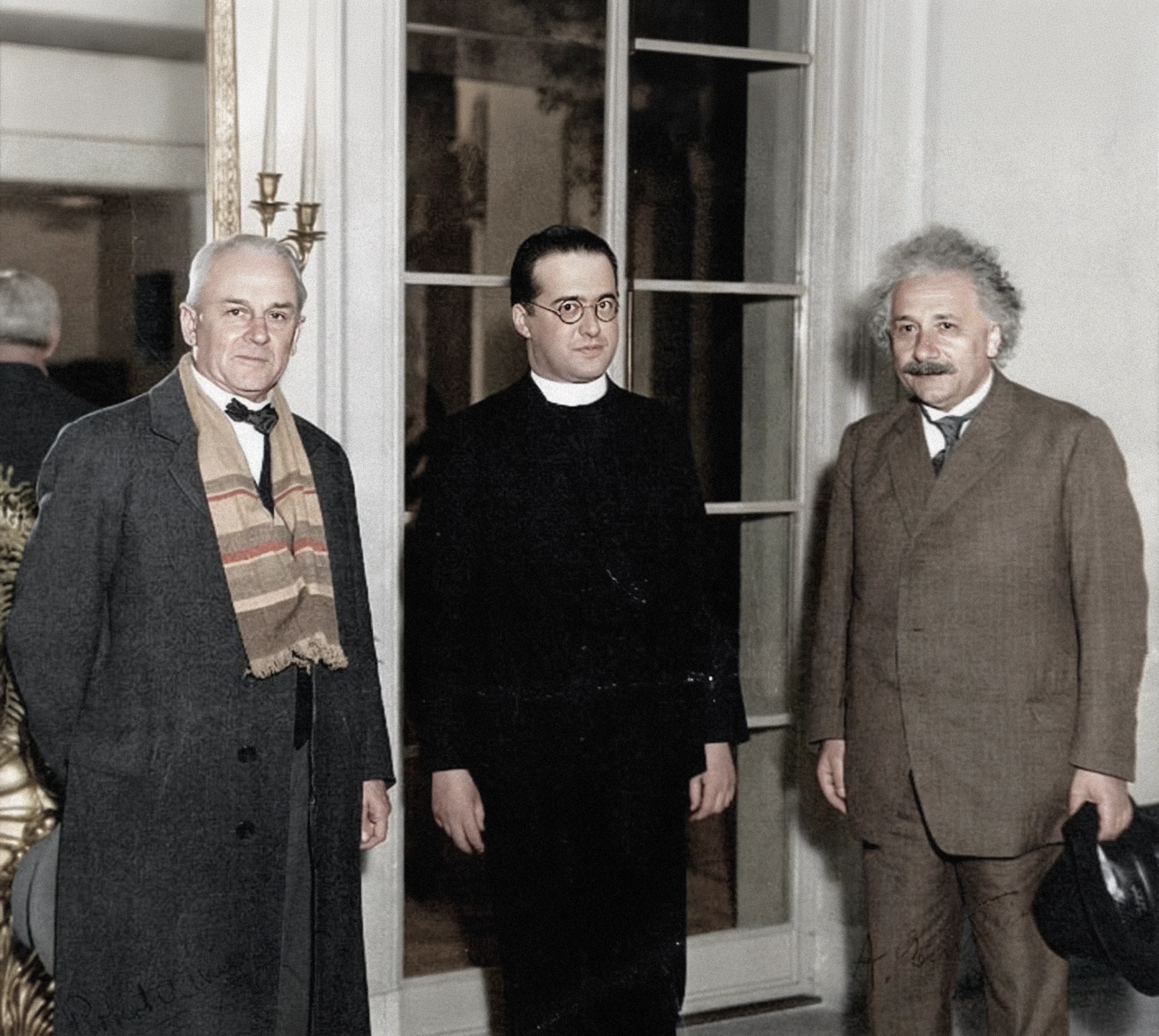
The two men first crossed paths in October 1927 at the prestigious Solvay Congress in Brussels, a gathering of the world’s top physicists. Lemaître had the chance to discuss his 1927 paper on the expanding universe with Einstein directly. While strolling through the park near the conference, Einstein acknowledged that the math was solid, but made no bones about his contempt for the interpretation.
Vos calculs sont corrects, mais votre physique est abominable.
As a materialist, he found the notion of a universe with a beginning philosophically unsettling. It wasn’t logically clean. An eternal, steady state, on the other hand, had no need of an origin story.
Edwin Hubble and the Expanding Cosmos
While the theorists theorized, American astronomer Edwin Hubble provided the crucial observational support. Using the powerful telescope at Mount Wilson in California, he studied distant galaxies. In 1929, he noticed that their light was stretched toward the red end of the spectrum, a phenomenon called redshift. The farther away a galaxy was, the faster it appeared to be moving away. Space itself was stretching, carrying galaxies along like dots on an inflating balloon. This discovery aligned perfectly with Lemaître’s predictions.
Einstein eventually came around, accepting the reality of an expanding universe. He removed the cosmological constant from his equations, later referring to it as his “biggest blunder.” Ironically, decades later modern science brought it back to account for the universe’s accelerating expansion.
Lemaître and Einstein met again on several occasions, including in 1933 at the California Institute of Technology. After Lemaître gave a lecture outlining his ideas, Einstein received it with far less resistance. In fact, he stood up, applauded enthusiastically, and declared it “the most beautiful and satisfactory explanation of creation to which I have ever listened.”
The Big Bang
The catchy name “Big Bang” has an ironic backstory. In a 1949 BBC radio broadcast, British astronomer Fred Hoyle was explaining his preferred Steady State model of the universe, a theory which imagined an eternal cosmos with no true beginning.
While contrasting it with the idea of a sudden origin, he referred to it as “this big bang,” mocking what seemed to him a sensational and unfounded theory.
Hoyle continued to reject the expanding-universe model for the rest of his life. Yet his “Big Bang” description stuck, gradually became the standard name for the theory.
The Accidental Discovery
The most convincing piece of evidence for The Big Bang arrived unexpectedly in 1964. Radio astronomers Arno Penzias and Robert Wilson were working on a massive horn-shaped antenna at Bell Telephone Laboratories and picked up a persistent, faint hiss coming from every direction in the sky. They couldn’t figure out what it was, and in desperation spent hours scraping bird droppings off the antenna.
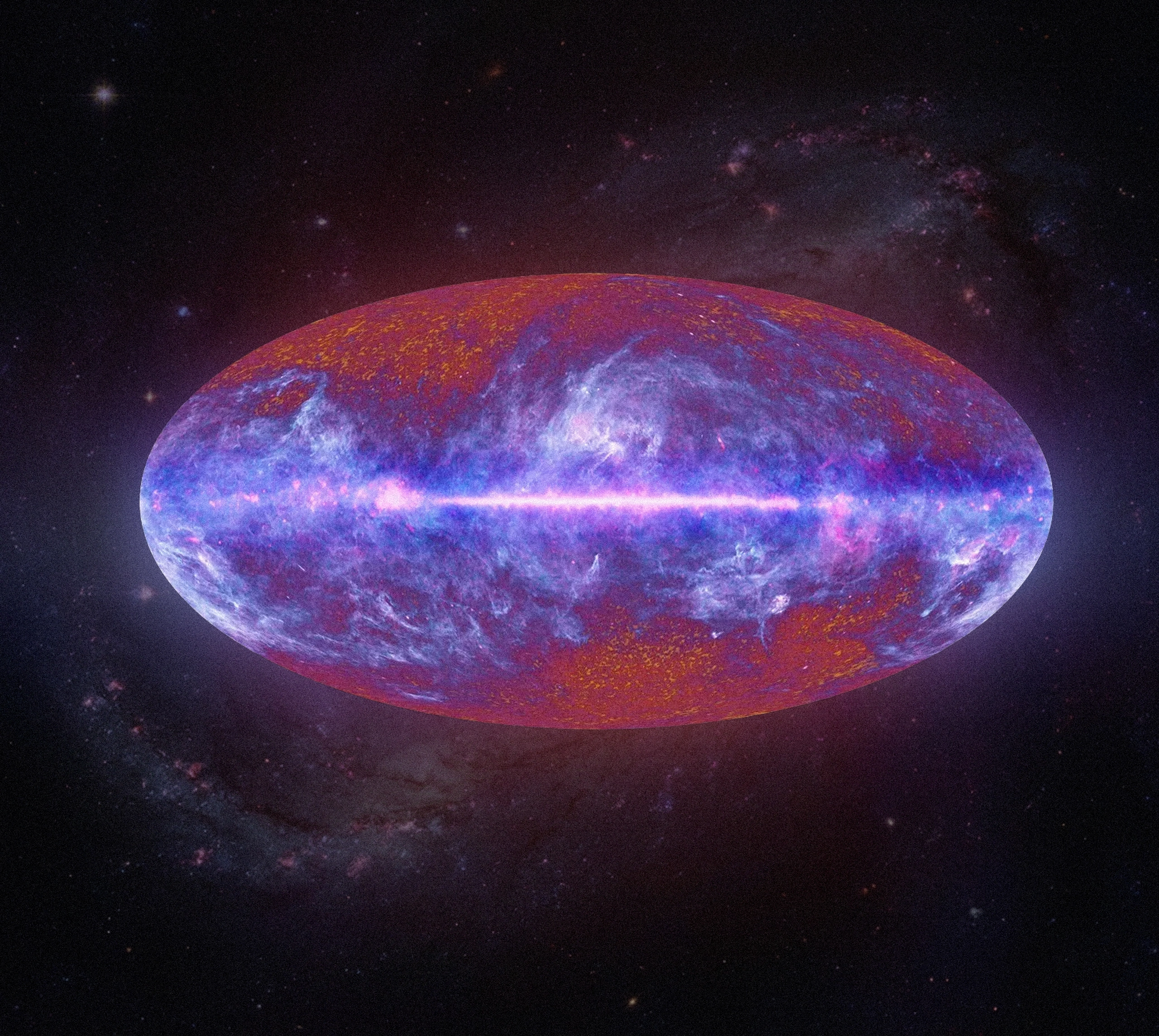
And then it clicked. A friend shared that a paper by Jim Peebles theorized that there must be radiation left over from the Big Bang explosion. What Penzias and Wilson had detected from the antenna fit the exact description of what scientists were looking for: the Cosmic Microwave Background.
Penzias and Wilson had discovered the cooled remnant of the universe’s earliest moments, an ancient echo confirming it was once in an extremely hot, dense state and has been expanding and cooling ever since. Scientific support for the Big Bang galvanized, and Penzias and Wilson went on to win the Nobel Prize for Physics.
What It Means for Us Today
Today, the consensus is remarkably strong: the Big Bang framework best explains the observable universe. It accounts for the expansion we see, the leftover radiation, the redshift, and the large-scale structure of galaxies.
Understanding the Big Bang invites us to see our place in a much larger story. Every atom in your body, every star in the sky, traces its origins back to that primordial moment. The universe isn’t a static backdrop; it’s dynamic, evolving, and still expanding right now.
For many, this perspective brings a sense of awe and humility. It connects us to deep questions that science, philosophy, and personal reflection all explore: why does anything exist at all? What shaped the early universe so precisely that stars, planets, and life could eventually emerge?
The story of the Big Bang, and the evolving relationship between minds like Lemaître and Einstein, is ultimately a testament to human curiosity. It shows the willingness to follow evidence, even when it challenges our assumptions or shakes our worldview. New observations continue to refine our understanding, revealing more details about those first moments. As we peer deeper into space, we’re also looking further back in time, getting ever closer to the universe’s mysterious origins.
Why Telescopes Are Time Machines
If you look at the Sun, you’re seeing it as it was 8 minutes ago, because sunlight takes 8 minutes to reach Earth. If you look at the nearest star (Proxima Centauri), you’re seeing it as it was over 4 years ago. A typical galaxy at a moderate distance might be 200 million light-years away, so we’re seeing it the way it looked when dinosaurs roamed the earth.
Are They “Real” Galaxies?
Telescopes truly are time machines; everything we see in space we are seeing as it existed when the light started traveling, sometimes millions or billions of years ago.
We’re not seeing “ghosts” or galaxies that have disappeared. They still exist out there, forming stars and orbiting within their clusters, they just don’t look the same because we haven’t received their current light yet. They are millions or billions of light-years away, so no matter when we view them they’ll always appear that many years younger.
And as long as we remain on Earth we’ll encounter this delay; even sending a telescope halfway to a distant galaxy wouldn’t reduce it. The time it would take to transmit the image back to Earth would be roughly the same as the time it would take the galaxy’s own light to finish reaching us!
What Is Redshift?
As light from a galaxy travels across the universe, its waves stretch out, shifting to the red end of the spectrum. This is redshift, a cosmic ruler.
Any redshift value (z) greater than 0 means a galaxy is moving away from us. Negative values mean it is coming closer.
Why Does One Galaxy Appear Three Times?
This image, captured from the Hubble telescope in 2014, shows a giant galaxy cluster called Abell 2744, also nicknamed Pandora’s Cluster. The bright, blurry blobs you see are mostly galaxies in this cluster, located about 4 billion light-years away from us. Scattered all around are thousands of other galaxies at various distances.
All three insets (a, b, and c) are actually pictures of the exact same galaxy. It is extremely far away, over 13 billion light-years, one of the most distant galaxies known at the time. We are seeing it as it existed when the universe was only about 500 million years old, a real “baby galaxy” from the early universe.
It appears three times because of gravitational lensing; the cluster is so heavy that its gravity bends and magnifies the light coming from the tiny galaxy behind it, like a giant magnifying glass. As a result, the light from that one distant galaxy is bent into three separate paths. Each path creates a magnified image (a, b, and c). Without this natural magnifying glass, the galaxy would be too small and faint to see at all.
Birth of the Big Bang Theory
A short, clear overview of Lemaître’s work in the 1920s–1930s, his “primordial atom” hypothesis, and how it led to our modern understanding of the Big Bang. An excellent starting point.
Watch on YouTube →The Priest Who Discovered the Big Bang
An in-depth but non-technical lecture by astronomer Jonathan Lunine on Lemaître’s life, his scientific contributions, and how he reconciled faith and cosmology.
Watch on YouTube →