The Bleeding Host of Buenos Aires
 Grace Sylvester · July 11, 2026 · 17 min read
The Facts (and Errors) Surrounding the 1996 Eucharistic Miracle
In August 1996, an ordinary incident at the Parish of Santa María in Buenos Aires, Argentina, set off a chain of events that would become one of the most scientifically examined Eucharistic phenomena.
But what really happened?
The case has drawn significant attention due to its extensive documentation, the involvement of Pope Francis when he was Archbishop Jorge Mario Bergoglio, and subsequent laboratory analyses.
There are many articles and videos about this case, mostly one-sided pieces by believers or skeptics. These accounts are riddled with omissions, exaggerations, and errors, including the widespread use of completely unrelated photographs. It’s become an Internet feedback loop, one that AI now reinforces.
This account aims to break that loop using primary reports, video footage of first-party interviews and procedures, extensively analyzed photographs, and witness testimony. It’s thorough and accurate.
The true story is less sensational than the others but no less intriguing; it raises questions most religious accounts ignore and includes details skeptical accounts skip.
Ultimately, it leaves room for two conclusions: a hoax or something science can’t explain. The facts don’t support contamination as an explanation.
The Incident
On Sunday, August 18, 1996, after the 7:00 PM Mass at Santa María church, a parishioner discovered a consecrated host on the floor. This woman was a Eucharistic Minister acquainted with the parish (and was later interviewed on video), but her name has not been reported. Fr. Alejandro Pezet, the priest, referred to her as “a saintly woman” he knew well.
Fr. Pezet, praying nearby, instructed her to place it in a container of water and store it inside the tabernacle. She reportedly added it to a dish with tap water from the baptismal font (not distilled water, as other articles claim). Per Church protocol, it would be left to dissolve, then poured down the sacrarium, a sewer-bypassing drain.
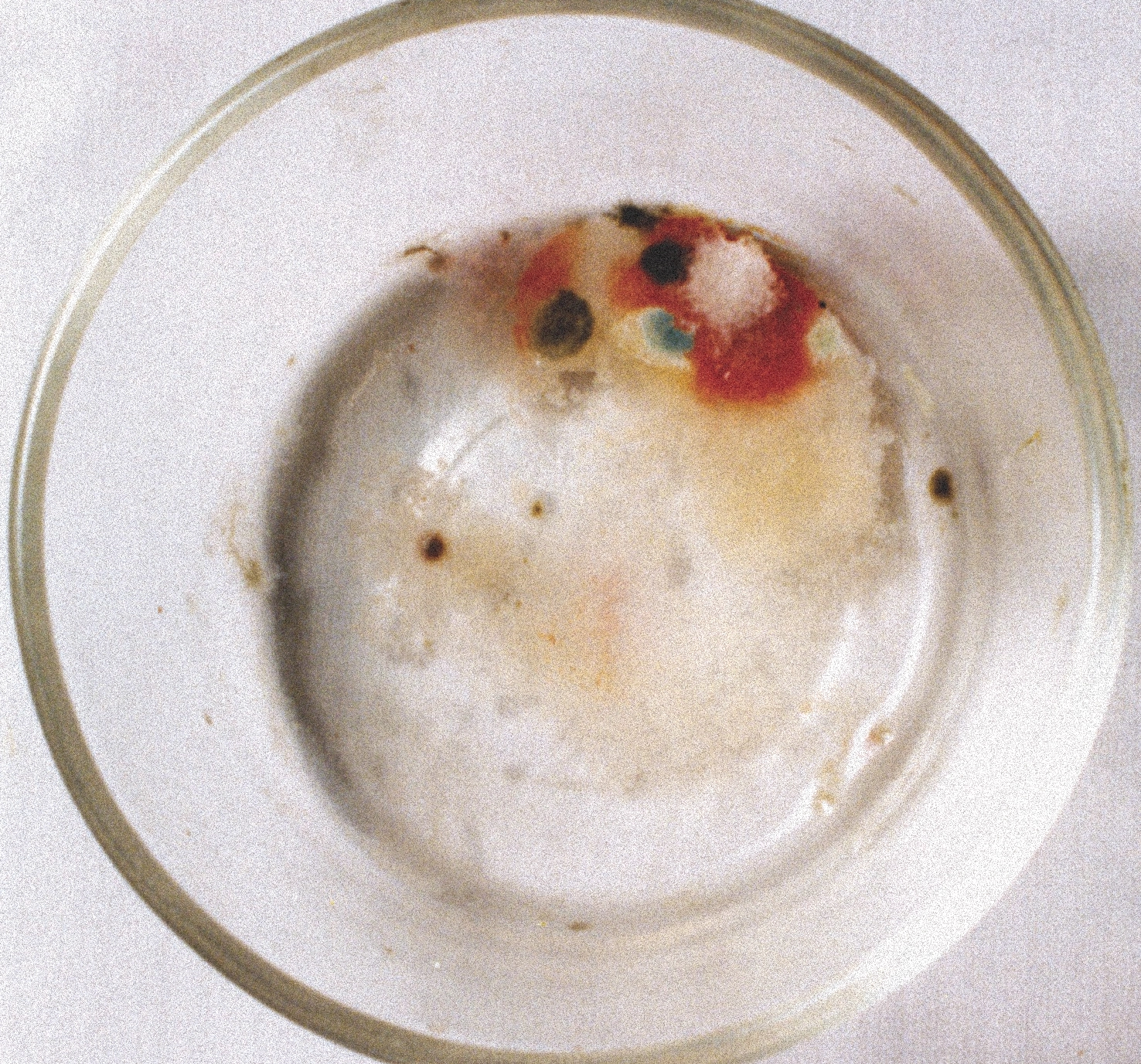
On August 26, the same woman checked the tabernacle and found that the host had not fully dissolved and contained red sections. She told Fr. Pezet, who took a look. He photographed the contents of the dish (shown below in Image 1) and removed it from the church, placing it inside a different tabernacle in the rectory — accessible to no one but the resident parish priests, where it could continue dissolving undisturbed. By his testimony, he did not seem overly struck at this stage and did not alert the bishop.
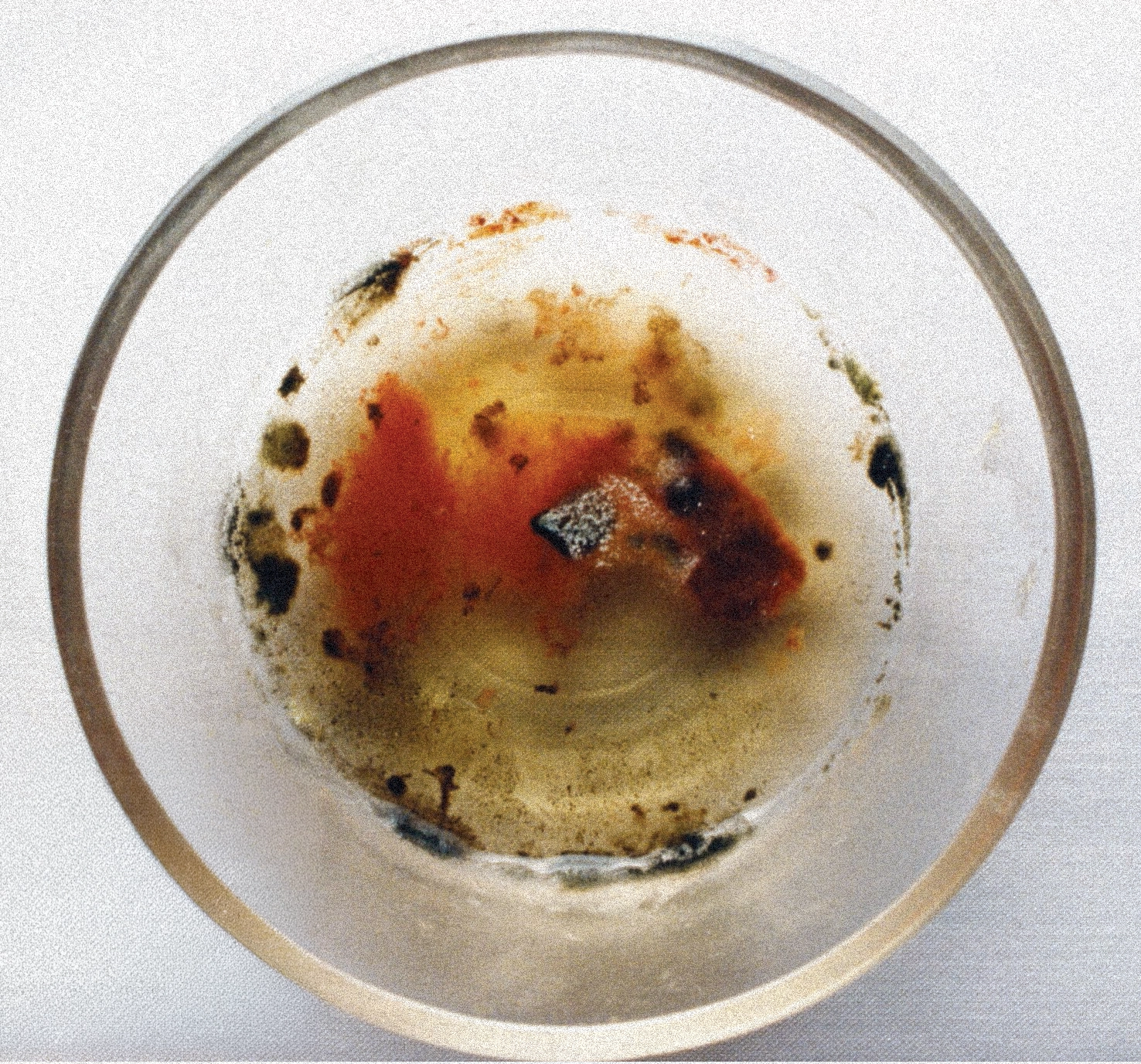
His disposition changed on September 6, eleven days later. The red substance had become brighter, more viscous, and increased in volume. It was now clearly distinct from other areas that looked like mold. Fr. Pezet immediately informed Archbishop Bergoglio.
The Photographs
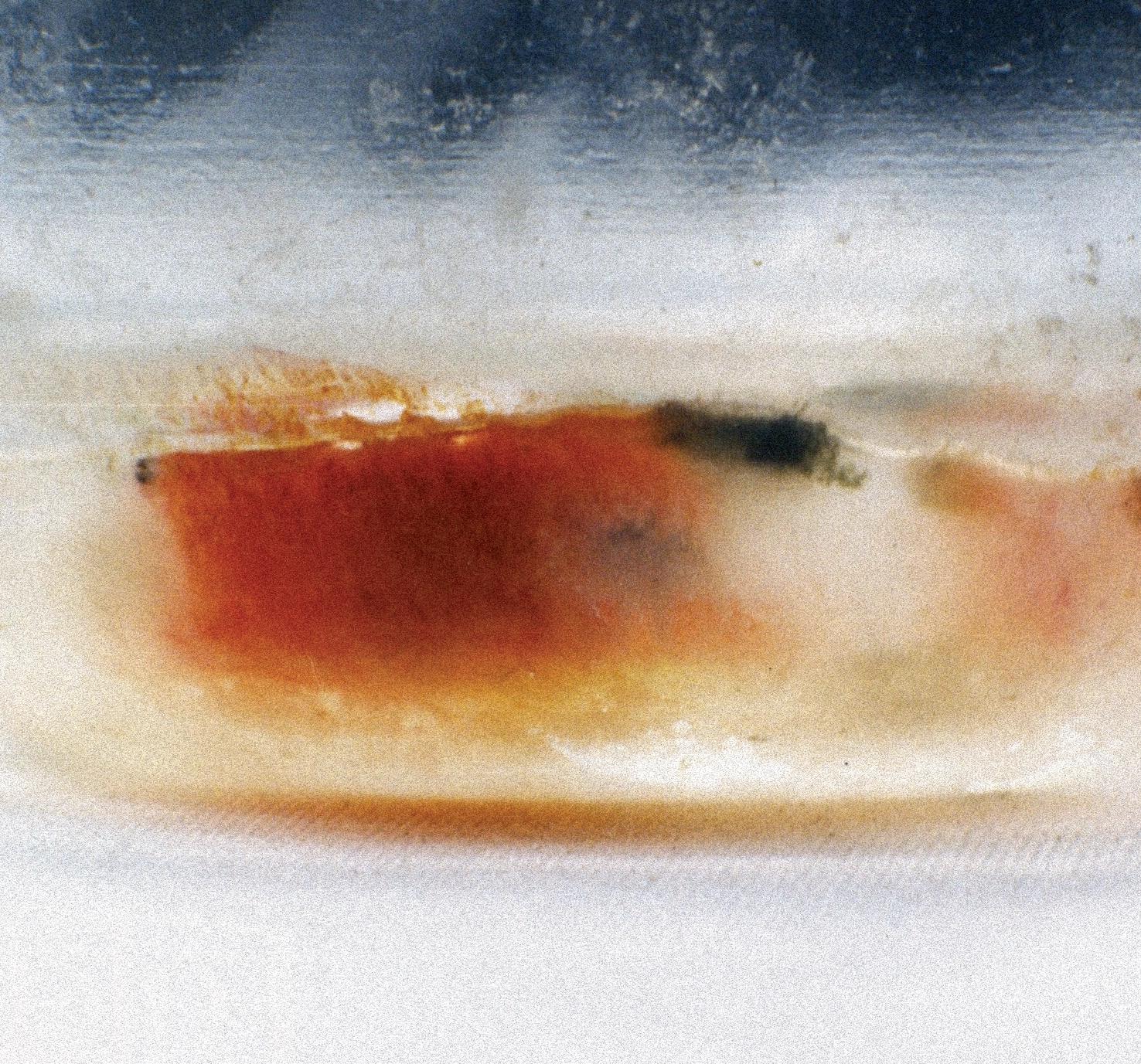
Bergoglio instructed that the host be photographed and returned to the tabernacle. The priest was to then change the water to sterilized water and continue observing it privately, without drawing public attention. Below are three images — the first two taken on August 26 and the third on September 6.
These photographs are regularly mis-reported or mistakenly attributed to the incorrect dates. The dates are not clearly stated in the public Vatican write-up (just that Bergoglio ordered some to be taken on September 6, 1996).
However, during a videotaped presentation, Fr. Pezet explains that the first image (of the partially dissolved host) was “what he saw” on August 26, implying it is a photograph from that date. He also showed a slide of Image 3 and, gesturing toward it, discussed how the host had changed on September 6.
A Study Begins
Soon after photos were captured on September 6, 1996, the host particles were removed from the glass dish and placed in a glass vial of distilled water. There is no reported discussion, at this stage, of opening an investigation.
Over the next three years, the host reportedly showed no signs of decomposition. It remained in the private rectory tabernacle.
In 1999, Dr. Ricardo Castañón Gómez, a Bolivian clinical psychologist, offered to conduct the investigation free of charge. He had assisted in the study of a prior Eucharistic event and became intrigued by the Buenos Aires case, although we don’t know how he became aware of it. His conversion to Christianity was arguably already underway at this time, despite wide reports of his atheism. Of those related to the investigation, he draws the most criticism for his blatant bias and misleading claims about the DNA results.
The Bishop authorized the investigation, which would take about five years to complete.
Blind by Design
Despite Gómez officially leading the charge, it was Australian attorney Ron Tesoriero who played a far bigger role. He was invited by Gómez and became heavily involved; he assisted with the sampling, coordinated tests, personally attended pathology exams, and documented the investigation. It was Tesoriero who reported the findings to Bergoglio and the case to Carlo Acutis (for what would later become a Vatican exhibit).
Prior to testing, Tesoriero interviewed Fr. Pezet and the female parishioner. This can be viewed, at least in part, in Tesoriero’s documentaries embedded below.
The testing involved blind sampling to reduce bias; experts were not told the origin of the material. Sampling occurred on film, with researchers and church officials present. Most of this footage is included in the first documentary below.
A single sample was examined by two laboratories and five specialists across North America, Australia, and Europe. Testing occurred in two waves over the course of the investigation, with additional testing a decade later. In addition to the pathologists who tested the physical sample, a sixth expert reviewed enlarged slide images.
A Timeline of the Evidence
Each pathologist and lab was sent or hand-delivered the same sample without history or context. Here is every finding, in the order conducted.
Forensic Analytical Genetics — San Francisco
Found human DNA. A PCR STR analysis could not be completed for lack of material. Blood type was AB, matching other Eucharistic phenomena and the Shroud of Turin. Referred to Dr. Robert Lawrence.
Dr. Robert Lawrence — forensic histopathologist, California
He observed human skin and white blood cells, reporting “active, living white cells at the time they were collected.” In 2004, he revised his conclusion to heart tissue after reviewing Dr. Zugibe’s findings.
Three pathologists — Australia
Dr. Peter Ellis (Westmead Hospital, Sydney) and Dr. Tom Loy (University of Queensland) both found human skin and white blood cells. Dr. John Walker (Sydney University) found muscle and white blood cells.
Dr. Edoardo Linoli — Hospital of Arezzo, Italy
He believed he saw heart tissue but made no definitive statement, reviewing printed slide images rather than the sample itself. Linoli is the same pathologist who studied the eighth-century Lanciano host.
Dr. Frederick Zugibe — cardiologist, New York
He observed human heart tissue with white blood cells and, like Lawrence, said the sample came from a living heart that had undergone trauma. Zugibe was the last expert to participate — and the only heart specialist.
Menarini Silicon Biosystems — Bologna, Italy
Tesoriero apparently sent a fragment for another DNA analysis, reporting that mitochondrial DNA testing “yield[ed] valuable specific data on the genetics of the ‘person’s’ mother,” but the results were never published.
Of the six professionals consulted, three found heart tissue (with varying degrees of certainty) and three found white blood cells and either skin or muscle.
Under the Microscope
Dr. Zugibe’s findings are the most well-documented and the most widely reported. He examined the sample using stained paraffin-embedded sections viewed under a light microscope at approximately 400x magnification. He concluded that the tissue was human heart muscle from the wall of the left ventricle near the valves, with white blood cells present.
The tissue showed signs of inflammation and damage consistent with a heart attack or physical blow; an injury that should have but did not cause death. The white blood cells indicated the tissue was alive when the sample was taken.
Most notably:
- The tissue did not decompose after three years in water.
- The presence of white blood cells suggests the tissue was reacting to stress, which means it continued living after undergoing trauma. Multiple pathologists confirm this.
- Of the six experts consulted, three identified heart tissue (including the sole cardiologist) and three did not.
- The blood type was identified as AB.
Case Criticism
The analyses describe cardiac tissue with living characteristics. However, critics have raised questions about methodology, confirmation bias, and exaggeration.
A particularly scathing reproach—from a Catholic paper, no less—accused researchers from the Buenos Aires case and other cases of exaggerating the amount of DNA found and underplaying the full results. This criticism is directed almost entirely at Gómez, who claimed, during a speaking event to a Christian audience, that “no result” is evidence that the blood belongs to Jesus. That logic is a stretch by any scientific standard; the sample simply didn’t have enough genetic material to sequence.
Additionally, Tesoriero’s reported 2016 DNA test has drawn more scrutiny than confirmation. Based on the limited information Tesoriero has shared about its conclusions, it would give strong support to the case. But because he has not published the results, critics have called it into question.
These criticisms are centered around the DNA, not the tissue analyses. In general, critics have not questioned the pathologists’ credibility or the validity of their findings.
Other criticisms include
-
01
Lack of a controlled environment
The host was in the possession of a church, not a controlled environment, for an extended period of time. The chain of custody relies on witness testimony, not key logs or security cameras.
-
02
Lack of trained technicians
Sampling and delivery were not conducted by trained lab technicians. Researchers were transparent—videotaping the activity with witnesses present—but were not experts. The sample was shipped to one lab (Dr. Lawrence) and hand-delivered by Tesoriero to the remaining pathologists.
-
03
Inconsistent observations
The same sample was reviewed by five doctors, with images provided to a sixth, but the findings were not consistent. Three observed human heart tissue (Zugibe with certainty, Linoli noncommittally, and Lawrence years after his initial assessment). The remaining three—all Australian pathologists who reviewed the sample around the same time—did not, though they did identify white blood cells.
And of course, it’s important to note that this incident has not been declared a supernatural miracle in any peer-reviewed scientific journal.
Church Approval
When the host was discovered bleeding in 1996, then-Archbishop Jorge Mario Bergoglio—the man who would become Pope Francis—authorized a thorough investigation. He ordered the host to be professionally photographed and, later, allowed samples to be sent for scientific analysis.
Prior to relocating to Rome for his papacy, Bergoglio visited the parish annually for Eucharistic adoration, reinforcing his personal regard for the event. The Archdiocese of Buenos Aires continues to allow veneration periodically in a special chapel at the parish.
The Vatican has not officially recognized this event as supernatural in origin, as it has in prior cases. Nevertheless, the case features prominently in the Vatican’s roaming exhibit on Eucharistic miracles, and Pope Francis’ devotion to it has carried enormous weight with Catholics.
Miracle or Hoax?
Given the evidence, there are two possible conclusions: a supernatural event occurred, or we’ve been hoaxed. The scientific observations do not leave room for the possibility of mere contamination.
Let’s examine what a hoax would have involved, and why contamination cannot be responsible.
Hoaxed sample
In this scenario, the sample was swapped with heart tissue. Since it was never stored in a lab (with the exception of the San Francisco lab, which analyzed only the blood, not the tissue), an accidental mix-up is not possible. It had to be intentional.
Importantly, the swap would have had to occur very close to the analyses—probably twice. If Dr. Zugibe was truthful, the tissue came from someone whose heart was pumping blood just days before the analysis, meaning it had been collected from someone who had recently died. And because Lawrence revised his own findings from his own slides, his sample would also have been swapped, misidentified, then identified as cardiac.
While macabre, this scenario is not impossible.
Hoaxed results
In this scenario, at least three people conspired to hoax the public: the two pathologists who identified heart tissue from the physical sample, and either the priest, the bishop, or one of the researchers.
For this to succeed, both pathologists would have needed to falsify their findings and their microscope images, and someone else—or several people—connected to the case would have needed to organize the hoax.
Potential hoax motives
Hoaxes are often suspected in difficult-to-explain cases. Whether a hoax is a reasonable explanation depends on motive: who had more to gain than the effort, money, and reputational risk would have cost?
- Priest — parish enrichment Miracles bring venerators and donations. However, the event was not publicly promoted by the parish for years. It wasn’t until Gómez went directly to the bishop that an investigation was opened and the public informed.
- Bishop — diocesan enrichment or attention If the future Pope Francis had impure motives, he would likely not have waited three years to allow an investigation, and would have sought one himself rather than waiting for a researcher to approach him.
- Investigators — enrichment or fame Gómez went on to speaking engagements, often over-sensationalizing this and other cases. Tesoriero published a documentary and, 27 years later, a book. The proceeds appear modest at best and far removed from the event.
- Pathologists — bribery? Of the three doctors who observed heart tissue, only two were given actual samples, and neither published books or went on speaking tours. That leaves bribery—but it’s hard to imagine they’d both risk their medical careers for a religion scam.
The only realistic motive rests with the researchers. That would mean one or both obtained recently-living heart tissue on at least one occasion—which still does not explain the white blood cells the Australian experts found, or why the researchers would send non-heart-tissue samples for analysis.
Why Not Contamination?
The most common explanation for this and other reported Eucharistic miracles is contamination: remnants of skin, trace blood, or tissue that happened to be on someone’s fingers, transported onto the host or sample.
Why isn’t this tenable here? Every pathologist detected white blood cells, and three identified heart tissue. Heart tissue alone might be explained by contamination—a surgeon with traces on their fingers—but more than heart tissue was found, and the analyses occurred three years after the host was dropped. If Dr. Zugibe was not hoaxing us, those heart fibers were alive just days before testing, which a years-old contamination cannot explain.
Contamination likely accounts for the skin cells, and possibly the human DNA. But it can’t easily explain the heart tissue—and it can’t at all explain the presence and disposition of the white blood cells. If it wasn’t a supernatural occurrence, it had to be a hoax: a conspiracy involving at least two pathologists and a lawyer, scientist, and/or cleric—or someone who obtained heart tissue from a person who had just died, possibly on two occasions.
What do you think happened?
Below, review the timeline, chain of custody, and additional resources.
The Sample
-
Parish
The host is discovered by a parishioner in Fr. Pezet’s presence. It is stored first in the parish tabernacle and soon after in the rectory tabernacle. It is checked at least twice.
-
Gómez & Tesoriero
Sampling occurs; researchers and church officials are present and the session is videotaped. Gómez or Tesoriero take custody, mailing it to a lab soon after.
-
Lab in San Francisco
The sample arrives by mail to a forensics lab in San Francisco in late 1999. After testing, the lab provides it to Dr. Lawrence some time before January 2000.
-
Dr. Lawrence
Dr. Lawrence studies the sample in January and returns it to Gómez or Tesoriero prior to March 2000.
-
Tesoriero
From March to May 2000, Tesoriero (who is Australian) hand-delivers the sample to three pathologists in Australia—Dr. Ellis, Dr. Loy, and Dr. Walker—documenting each analysis. In 2004, he and journalist Mike Willesee bring it to Dr. Zugibe in New York, who examines it on video. It is either returned to the parish or kept with Tesoriero.
-
Parish and/or Tesoriero
The sample is either returned to the church (presumably added to the host) or remains with Tesoriero. Tesoriero reports taking a portion to a lab in Italy for another DNA test, but the date is unknown and the results have not been published.
Below are two documentaries produced by researcher Ron Tesoriero, which contain first-party interviews, footage from testing, and more. Some of this information can only be seen in one or the other, so it’s best to watch both for the full picture on the Buenos Aires case.
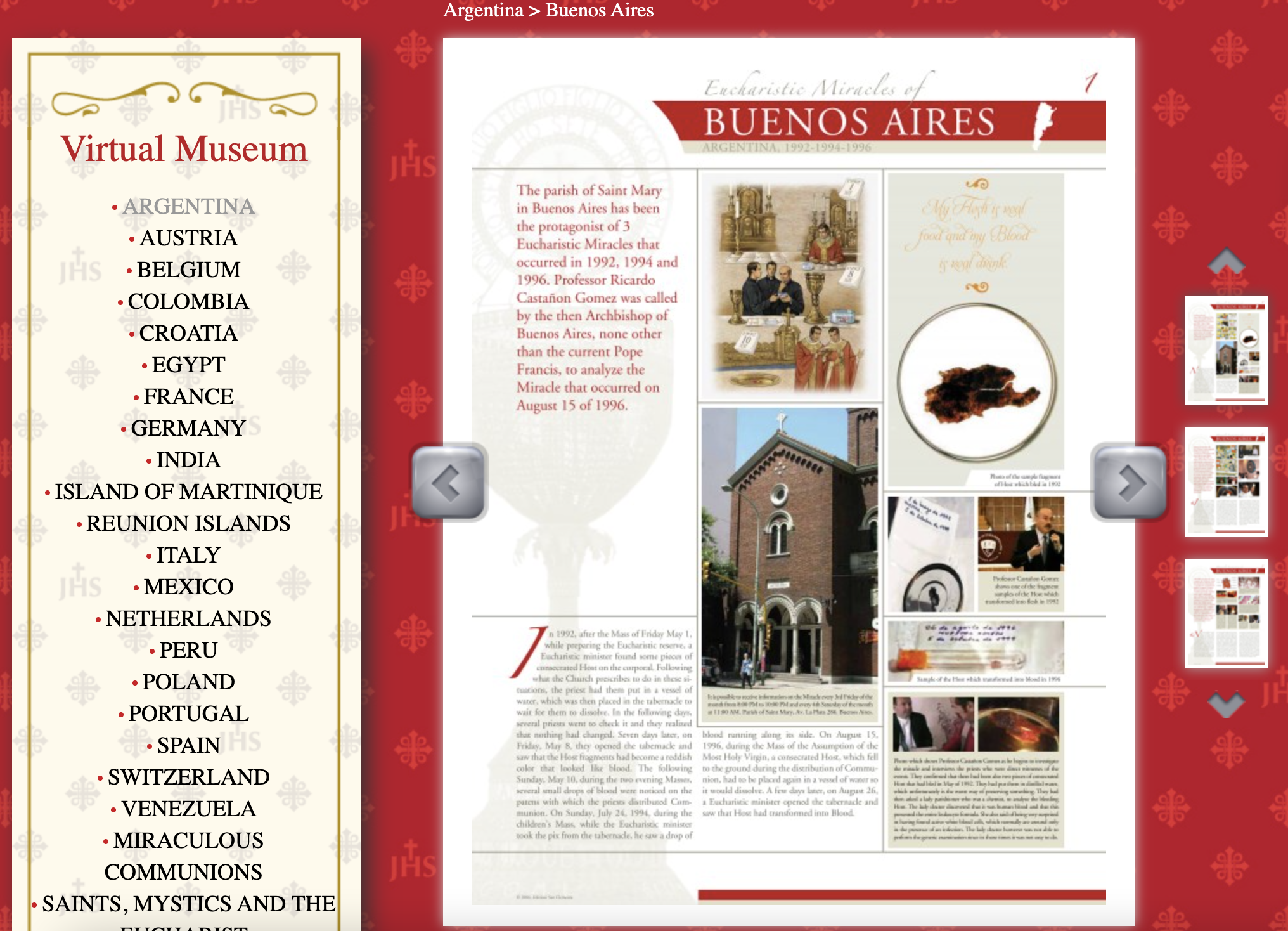
Additionally, below are a few great resources to continue exploring Eucharistic Miracles. The oldest still-venerated sample dates to 750 (Lanciano, Italy).
Ron Tesoriero Presents Scientific Evidence
This Tesoriero video has a clear religious angle and touches on other phenomena unrelated to Buenos Aires—but it contains excerpts from Dr. Zugibe and others not published elsewhere.
Watch on YouTube →Jimmy Akin’s Mysterious World: Eucharistic Miracles
Jimmy Akin—an analytical, apolitical Catholic apologist known for critical reviews of supernatural claims—breaks down three reported miracles, including Buenos Aires. His examination is careful, clinical, and fair, closing with his “faith” and “reason” perspectives.
Watch on YouTube →